
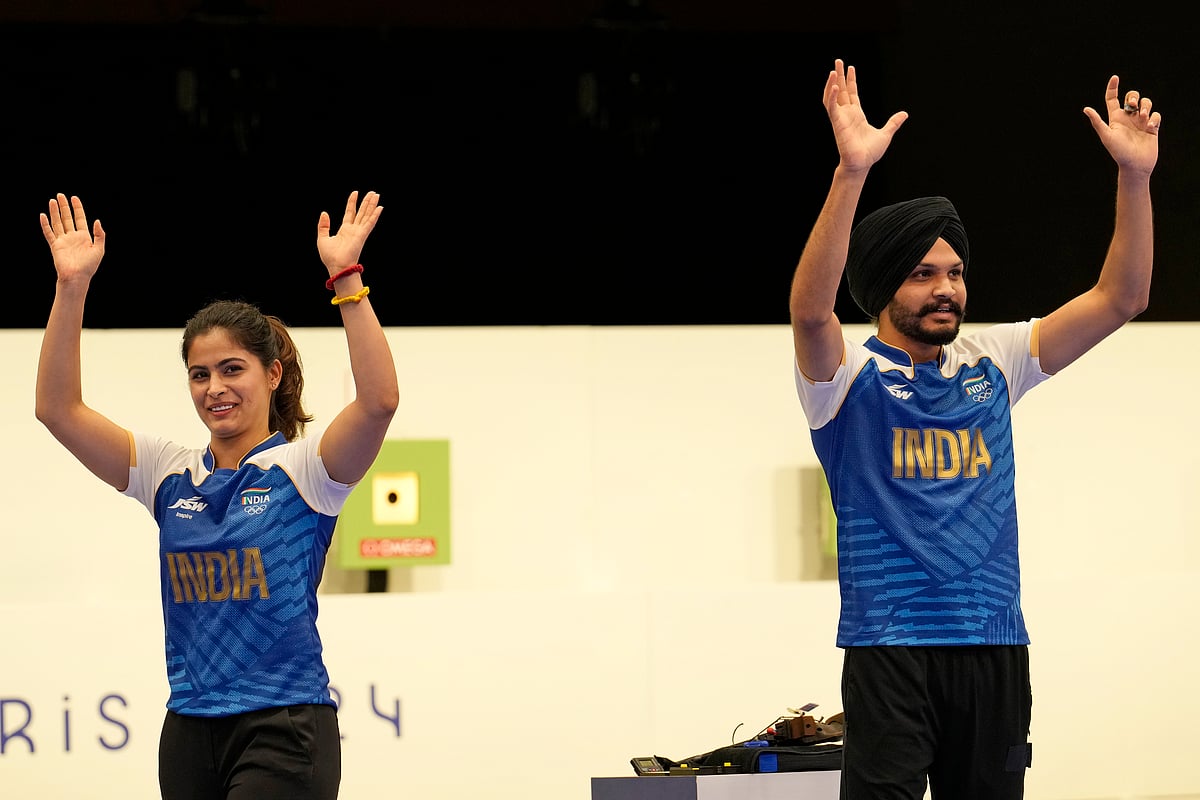
CHATEAUROUX (FRANCE): Just after they beat the South Koreans, Manu Bhaker and Sarabjot Singh were in a huddle with foreign coach Munkhbayar Dorjsuren. Raw emotions flowed as the enormity of the achievement started to soak in. Manu came towards the India crowd that cheered them from the stands and asked for the flag.
Sarabjot stood there as if in a trance, fixed to the spot. His coach was gesturing from the stands to take another flag and wrap it around him. He was lost in his world and did not see him. One cannot blame him. This is his maiden Olympics and his first medal. Manu had already won a bronze in the 10m air pistol event a couple of days ago.
If it was raining last week, this time it’s the heat wave that’s troubling people. Tuesday it was hot and the sun was beating dawn relentlessly without mercy. Inside the hall, Manu and Sarabjot were warming the ranges with their immaculate shots.
Coming into the Games, Sarabjot was almost incognito, under the shadows of bigger names like Manu, Sift Kaur Samra and Arjun Babuta. Not too many people knew him. After Tuesday, his name will be taken alongside the greats, Abhinav Bindra, RVS Rathore, Vijay Kumar and Gagan Narang. The bronze medal will transform his life forever.
For Sarabjot, the journey from a village in Haryana to the podium at the Paris Olympics has been nothing but a magical dream. His success has involved a fair bit of struggle, sacrifice and hard work; a bit of steadfast dedication too. And, of course, a stringent training regimen where he was encouraged to be off the phone; forbidden to take a bike ride lest he met with an accident that would eat away into his training time. One thing his coach would not allow him: to miss training. “Never,” reiterates his coach Abhishek Rana.
Taking an hour-long journey on a bus from his village (Dheen in Haryana) to Ambala (and then back) every day is not an easy task. It takes a toll on the body and the mind. Perhaps this gruelling routine would have made him stronger, both mentally and physically.
“I used to leave home in the morning by bus and get home late in the evening,” he said. “That continued till I managed to get a car.” That was the car the 22-year-old shooter bought with the prize money he earned after his Asian Games medals (men’s team and mixed gold).
Home-cooked food packed by his mother for the day and the way his coach Rana’s household took care of him made Sarabjot forget the vagaries of his daily travels. When he confessed after the medal that he did get bored after two years, one must excuse him.
“Then I met a very good friend and he would motivate me,” said Sarabjot at the mixed zone. He was still in a trance and seemed lost. The victory was yet to set in.
Another friend proved to be a perfect foil too. “This friend is equally good and pushes him and when they shoot together, Sarabjot excels,” said the coach.